


By Ben Carsley, Vice President, Content & SEO
When you picture a car shopper beginning their path to purchase online, what does that journey look like in your mind?
Perhaps you envision someone going to Google, entering the name of the car they want, then browsing a list of options returned to them via search engine. Maybe you see a prospective buyer opening up ChatGPT, describing their lifestyle and budget, then waiting to see which SUVs are recommended by their very own AI assistant. Another shopper might watch TikTok videos of pickup cabin interiors to decide which one they like most. Yet another might use the Copilot functionality embedded in their PC to ask why their steering wheel has started shaking when they brake.
The truth is, consumers are now engaging in different versions of these online journeys millions of times each day. The rise of Large Language Models (LLMs), summarized search engine results, and new platforms, all frequently lumped together under a big bucket only somewhat accurately referred to as "AI," has broadened the digital playing field, all while passing less traffic through to websites as each search tool aims to keep users within its own ecosystem.
For dealers, this poses an existential threat to the digital advertising model that has powered customer acquisition for the better part of two decades. The good news is, to succeed amidst all this change, dealers don't need to master every emerging model, acronym or theoretical change in consumer behavior.
Instead, they need to keep their focus on capturing consumer intent wherever it surfaces.
At C-4 Analytics, we've spent the last three-plus years helping our dealers prepare for, then succeed in, the new AI Search Era. We've monitored changes to algorithms, adapted to new consumer behaviors, built out the technical infrastructure that powers results, and introduced new ways for dealers to measure their visibility online.
But while our techniques, tech and campaigns have evolved, the core of what we help dealers do remains unchanged. The mission has always been to help dealers compete for in-market consumers everywhere they search, shop, ask and scroll online. The ways in which people perform those actions may have changed, but shoppers are still ultimately expressing the same intent: looking for inventory, pricing, offers, financing, service information, local relevance, and reasons to trust one dealership over another.
As such, the dealers who are winning in the AI Search Era are not the ones chasing every new acronym or guessing which AI platform will win the search adoption wars. They're the ones who remain focused on building the infrastructure needed to show up wherever shopper intent appears.
AI Has Disrupted the Automotive Discovery Model
It is undeniably true that the online discovery model has changed for car shoppers. In fact, the way car shoppers discover vehicles, compare dealers, and research their next purchase has changed more in the past two-plus years than in the decade before them.
A decade or so ago, search was easier to understand. A consumer typed a query into Google or Bing, scanned a page of blue links and decided where to click. Dealers competed for that click by ranking well, running relevant ads and making sure inventory, pricing, offers and reviews were easy to find.
That version of search is on the verge of extinction. Search engines have been shortening the distance between a question and an answer for years. Featured snippets, map packs, inventory modules, shopping ads and local results all pushed consumers toward faster answers and fewer clicks. AI has accelerated that shift, and consumers are now more likely to see a single response or curated list than a menu of options to choose from.
The data reflects that reality. According to SparkToro, from January through April 2026, 68% of searches on Google ended without the user clicking through to the open web.
That change alone presents challenges to the classic search model dealers have used to fuel their marketing efforts for many years. But it's exacerbated by another evolution in consumer behavior that dealers are facing at the same time: that shoppers are increasingly using other tools in addition to search engines in their car-buying journeys.
Here, again from SparkToro, we see how consumers have adapted different tools and platform types as they search for information online: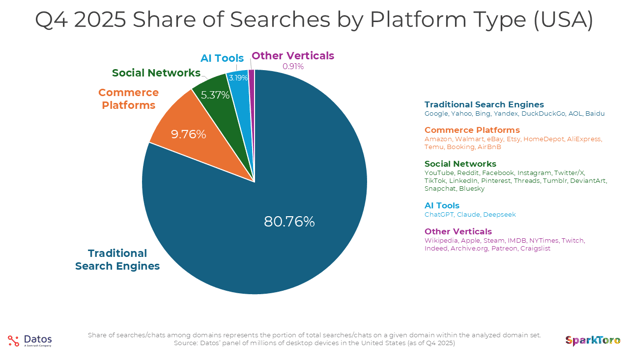
This broadening of the search landscape is supported by our own research: According to C-4 Analytics' latest QCIS Report, 64% of car shoppers say they plan to use AI during their next purchasing journey.
That does not mean shoppers are using search less. In fact, Google is seeing an increase in searches per person year over year. It means that consumers are using more tools in addition to search engines to express the intent that automotive dealers need to capture.
To put it simply: Dealers must now compete across a broader set of digital environments that each provide a more challenging environment in which to fight for visibility. That leaves us needing to answer one big, important question: How do you win in a fractured discovery landscape where AI is compressing the journey, but shopper intent remains as strong as ever?
Discovery Changes. Intent Doesn't.
At its core, the answer is simple: Dealers can win in AI Search by focusing less on the consumer's choice of platform or behavior, and more on creating infrastructure designed to capture their intent. Because while AI is reshaping the car-shopping journey, it is not eliminating automotive demand.
Consumers still search for vehicles. They still compare dealers. They still research financing, incentives, inventory, service availability, reviews and trust. Their questions don't change. What changes is how their intent shows up.
For example: A shopper searching in Google for "Subaru Outback specials near me" is showing clear purchase intent. So is the shopper telling ChatGPT, "compare the inventories of the five Subaru dealers closest to me, show me every new Outback in stock, sort by cheapest to most expensive, and flag which models have eligible incentives."
Those are not separate opportunities; they are the same opportunity expressed through different interfaces. Our marketing efforts may need to evolve to match the sophistication of that second journey, but both consumers are expressing the same intent.
One prevalent challenge right now is that dealers may see a decline in website traffic due to zero-click searches and LLM adoption and assume that means there's a corresponding drop in consumer interest in their products. But our QCIS data reveals relatively steady consumer interest since early 2025: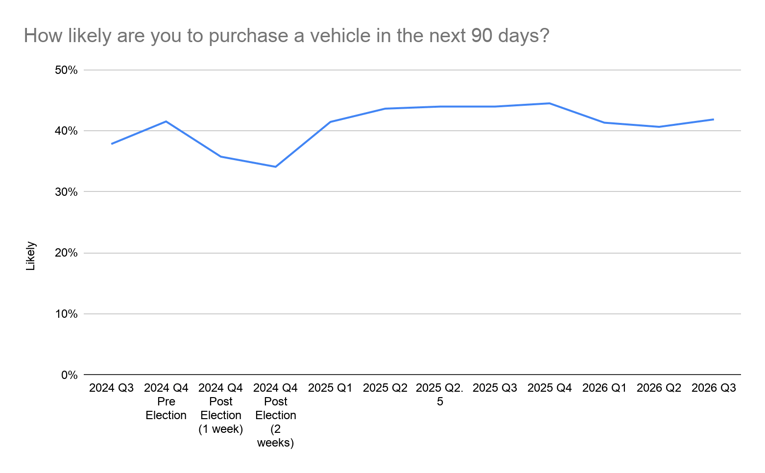
As such, the more acute risk is that a dealer's digital presence will lack the structured data, unique content and coordinated messaging required to be found and cited in all the places intent now manifests online. This can be particularly daunting given the proliferation of low-quality content wrought by access to LLMs, as well as the challenges automotive website providers have long faced in balancing ease of inventory management with maximum search engine discoverability.
In short, AI changes how consumers find what they are looking for. But it does not change what they are looking for, and it does not change the business value of being present when they look. That is why C-4 Analytics is coaching dealers to focus less on the AI arms race and more on the ways they're capturing consumer demand.
The Key to AI Search Success? Owning Intent Infrastructure
While it's important for dealers to understand how AI is changing the way car shoppers find information online, they do not need to become AI engineers, content creators or search specialists to succeed in this new environment. That's because the goal for dealers should not be to make the most educated guesses about where and how intent will manifest.
Instead, the goal is to build the infrastructure required to capture shopper intent wherever it surfaces.
At C-4 Analytics, we call the tools we've built to help our dealers earn maximum AI visibility our "intent infrastructure." This intent infrastructure includes the data, content, campaigns, feeds, partnerships, measurement systems and operating discipline required to make a dealership visible and credible across a fragmented search environment.
C-4 Analytics is built for the AI Search Era because we have spent years investing in the pieces AI search rewards, such as:
Data and Inventory Depth: AI systems need structured, accurate and current information. Dealers need partners who understand inventory feeds, pricing, OEM compliance, content structure, incentives, location signals and the messy realities of automotive data. This behind-the-scenes architecture is the key to telling search engines, LLMs and people alike what your dealership has to offer and why they should choose you.
Omni-Channel Execution: Google has historically and still presently owns the lion's share of high-intent search behavior. But shoppers no longer turn only to Google to shop or look for service online. C-4 Analytics has long empowered dealers to compete everywhere consumers shop, scroll, compare and search. That's especially important in an era in which search engines, LLMs and social media are all used interchangeably in buyer journeys.
Early Testing with Disciplined Adoption: To put it mildly, AI Search is moving quickly. The pace of change favors partners who test early, evaluate soberly and move in response to real business cases rather than headlines. Early adoption is in C-4 Analytics' DNA, and we pride ourselves on our ability to leverage our industry partnerships to help our dealers pivot faster than their competitors.
Together, these three pillars help dealers earn visibility in AI-influenced discovery without walking away from the fundamentals still driving traffic, leads and sales today.
Consider two specific examples. In organic search, where platform changes tend to manifest first, we've already seen the benefits of focusing on intent infrastructure amid platform and user sea changes. Our Content, SEO and Social Media Teams have aligned into one Organic Media discipline, leveraging quality, customized content to drive results across traditional and local search, AI Search (AEO/GEO), and social. This approach has helped our dealers earn visibility in emerging tools like ChatGPT and Google's AI Mode while still driving strong results across the search engines and social platforms that drive the vast majority of traffic today.
As paid advertising begins to embed into AI, we're following a similar discovery-agnostic approach. We test and experiment across emerging ad surfaces, adjusting budgets and tactics to drive maximum ROI. We're leveraging existing data and infrastructure to ensure AI-assisted campaigns like Performance Max and AI Max run as efficiently as possible. Yet we remain laser-focused on running the industry's most effective paid search campaigns, as we know that Google, Microsoft and others remain highly incentivized to leave their ad monetization models for highly commercial intent queries in place.
By investing in this intent infrastructure, in the data, content and campaigns needed to capture intent wherever it surfaces, dealers can both capture the leads of today while protecting themselves against whatever changes to automotive discovery may follow.
You Don't Have to Predict the Future. You Have to Own Consumer Intent.
The automotive industry does not need more AI hype or another search panic cycle. No vendor, analyst or thought leader can tell you with certainty which platform will win search market share or when and if buyers will change their habits. In truth, attempts to do so often lead dealers to miss the real assignment.
The real job is to own the intent wherever it shows up: to have the data, the content, and the campaigns in place so that when a buyer in your market searches, your dealership is the answer.
Yes, changes to AI Search are meaningful. They are changing how consumers discover information, compare options and decide which dealerships deserve their attention. But AI is not changing the underlying economics of shopper intent.
Consumers still need vehicles. They still need service. They still care about price, proximity, availability, trust and convenience. They still reward the dealers who make the path forward clear. That hasn't changed. What's changing is where and how that intent manifests online.
The dealers who continue to succeed in the AI Search Era will not be the ones who buy into the latest AI hacks or gamble successfully on one platform. They will be the ones building and refining the intent infrastructure required to show up consistently across the places shoppers search, ask, scroll and decide.
See Where Your Dealership Actually Shows Up
C-4 Analytics offers a Free Comprehensive Market and Digital Presence Analysis: a real, custom review of your website, your market, your competitors, and how visible you are across search and AI surfaces today. No generic pitch deck. No obligation.
About C-4 Analytics
C-4 Analytics is an advanced automotive digital marketing solution that helps hundreds of dealer partners sell more vehicles, earn more market share, and reduce marketing waste. Founded in 2009 and headquartered in Wakefield, MA, with offices in Ann Arbor and Chicago, C-4 Analytics combines media strategy, data science, and channel expertise to drive measurable outcomes at every stage of the purchase funnel. C-4 Analytics is a certified provider for OEM programs including Acura, Audi, Ford, GM, Honda, Hyundai, Jaguar Land Rover, Maserati, Mazda, Stellantis, and Subaru.