


2026 Auto Buyer AI Adoption Trends: Rising Consumer Trust, Usage Underscores Need for
Dealership AI Discoverability
Unlock Real-Time Auto Buyer Trends from the C-4 Analytics
Quarterly Consumer Intent Survey (QCIS)
The auto buyer hasn’t disappeared, but their path to purchase has become harder to follow.

The way consumers research vehicles has changed, and C-4 Analytics’ latest Quarterly Consumer Intent Survey (QCIS) puts hard numbers behind what many in the industry are already sensing.
Per our latest QCIS results, taken from a survey of thousands of in-market auto intenders, AI tools are no longer a curiosity that shoppers dabble with at the beginning of their research phase. They're becoming a routine part of the buying journey, layered on top of traditional search to compare options, validate decisions, and increasingly, choose a dealership. The path to purchase is more complex than it's ever been, and that complexity is creating new moments where dealers either show up or get left out.
The result is a more fragmented Organic Media ecosystem with more entry points where dealers need to establish a presence, protect their reputation and create content that meets evolving consumer needs.
AI Adoption, Awareness, and Trust Are Accelerating
The modern auto buyer journey is no longer linear, and it’s not even cleanly “hybrid.” It’s fragmented.
Shoppers move fluidly between OEM websites, third-party marketplaces, dealer sites, reviews, video, social media and AI tools, often looping back and forth before making a decision. There is no dominant starting point or predictable sequence. Instead, intent shows up in short, high-value moments across multiple channels.
QCIS data underscores this fragment
Consumers have moved past experimentation and are beginning to use AI more intentionally throughout the shopping process. In the study, 82% of respondents said they are at least somewhat familiar with AI tools like ChatGPT and Gemini, and more than half said they are likely to use AI during their next vehicle purchase. The most common mindset is "trust, but verify,” though a growing segment reports mostly trusting AI outputs without additional validation.
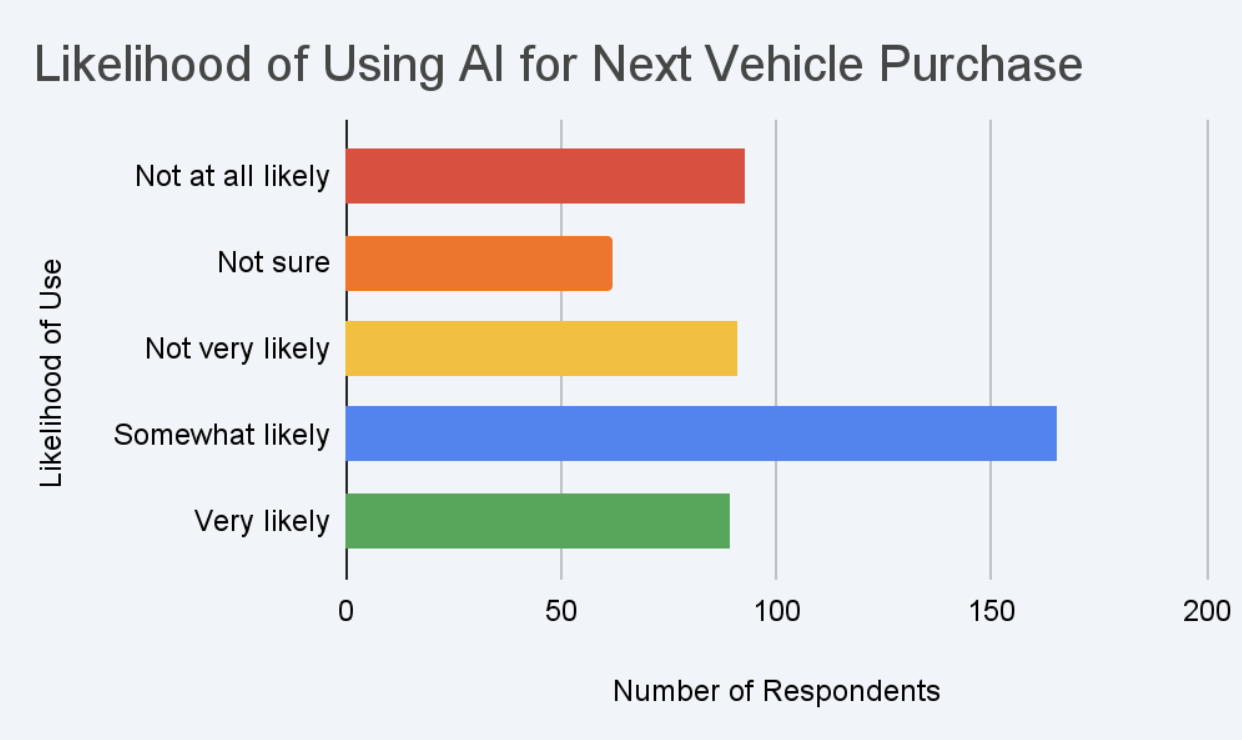
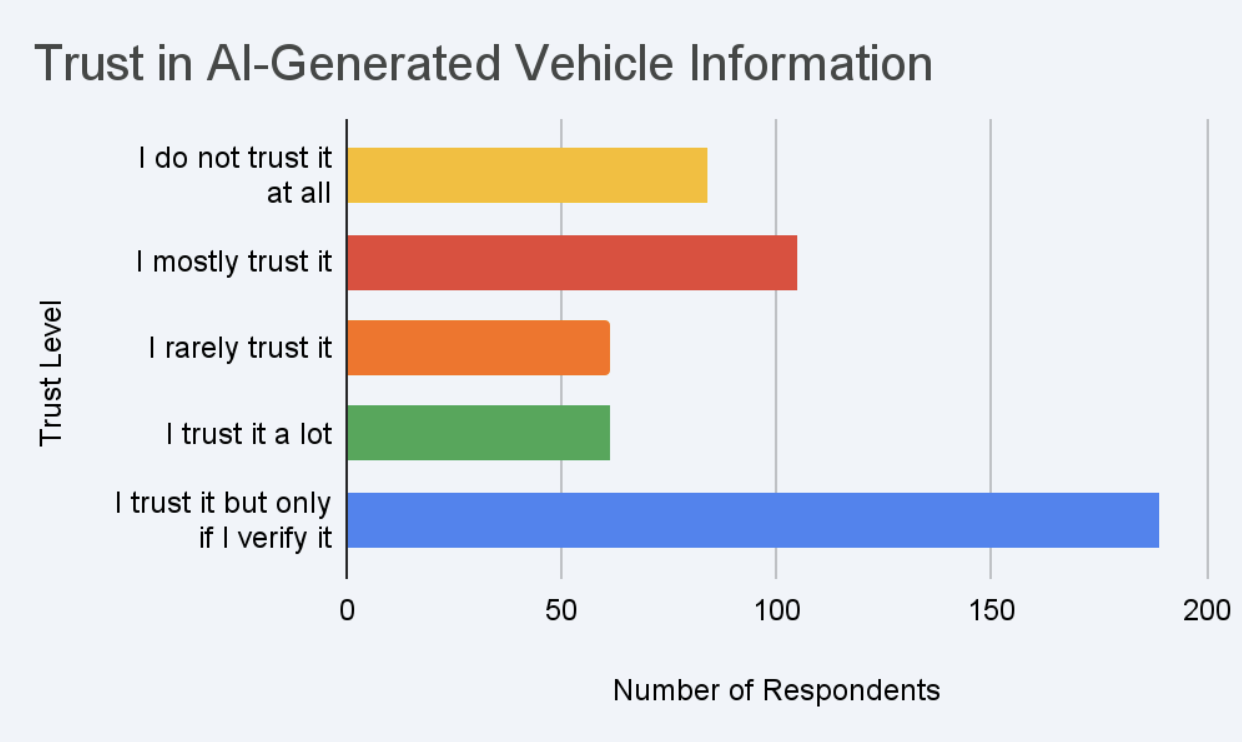
This doesn't represent a full handoff of consumer decision-making to AI. But it does reflect a meaningful and accelerating shift in shopping behavior. Consumers are comfortable using AI to speed up research, validate choices, and narrow down options.
Critically, they're doing so in addition to, not instead of, engaging with traditional search. Consumers aren't abandoning Google, but rather layering AI into the process, moving between search and chat depending on the task at hand. That layering creates more entry points into the buyer journey in which dealers need to compete.
Organic Visibility Now Spans Search and AI
As AI usage grows, the path to purchase becomes less linear. Consumers are asking AI tools to summarize their options, comparing vehicles in chat interfaces, and validating decisions across multiple platforms before committing to next steps. Traditional and local search still matter enormously, but they’re no longer the only places discovery happens.
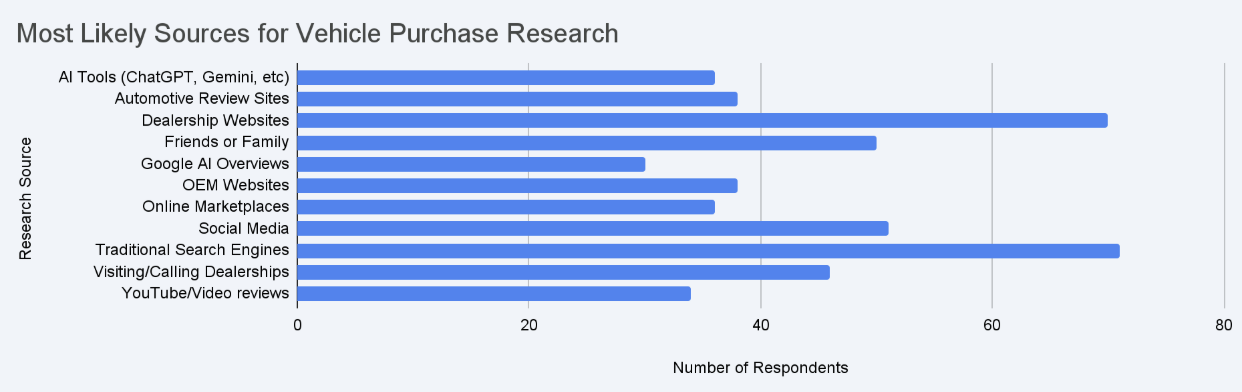
These results prove that dealers now need to be visible across both traditional search and the AI systems that are shaping recommendations and surfacing answers. It's a shift toward what we call a broader Organic Media ecosystem, where search rankings influence visibility, AI-generated answers influence consideration, and third-party sources shape both. As AI adoption grows, showing up wherever consumers search or ask questions becomes a baseline expectation, not a differentiator.
The Stakes: Winning the “Best Dealership” Decision
As consumer trust in AI increases, shoppers are pushing more of their decision-making into these tools, including one of the most consequential moments in the purchase funnel: Which dealership should I choose?
AI systems don't invent answers to that question. They aggregate signals from across the web, including:
- Reviews and ratings
- Local relevance
- Third-party content
- Consistent brand presence
In our study, shoppers reported using AI to find nearby dealerships, compare dealer pricing, and to synthesize reviews and expert perspectives into digestible summaries. These are high-intent moments, and the dealers most likely to be recommended in those moments are the ones who have built a visible, credible presence across the signals AI draws from. Dealers who haven't done so simply don't appear.
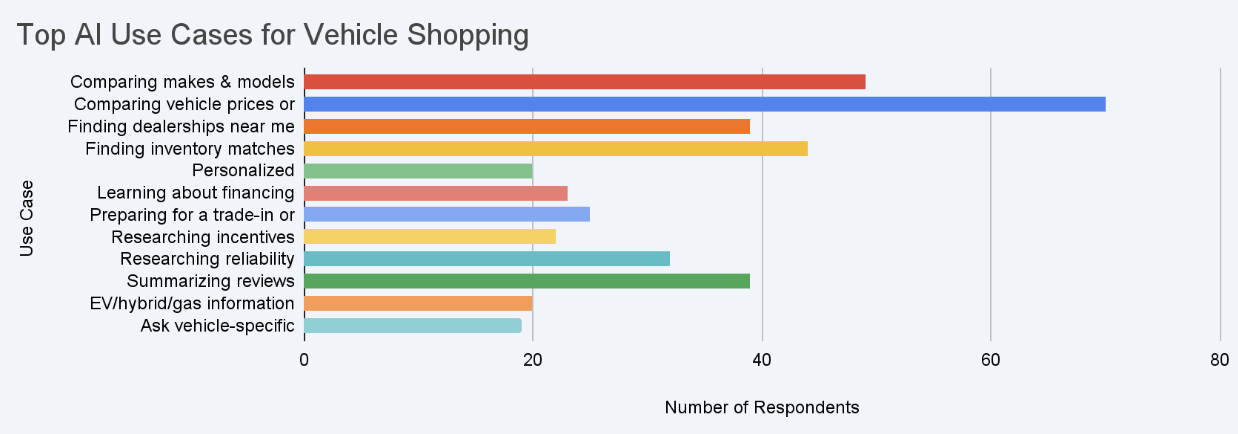
As trust continues to grow, these "best dealership" and “best price” recommendation moments will carry even more weight in the final decision.
What Shoppers Want from AI: Structured, Comparative, Local
The most actionable insight from the study isn't just that consumers are increasingly using AI, but how they're using it. The pattern is consistent across demographics: shoppers want help simplifying complex decisions.
The top use cases center on comparison, particularly comparing vehicle prices and value, and evaluating differences across makes, models, and trims. The formats consumers find most useful mirror that intent: side-by-side comparison tables are the most requested output, followed by monthly payment or ownership cost estimates and straightforward summaries of pros and cons.
Local relevance is equally important. Recommendations for local dealerships and nearby inventory rank among shoppers' top stated needs, reinforcing that AI isn't just being used for abstract research, but to make real, geographically grounded decisions.
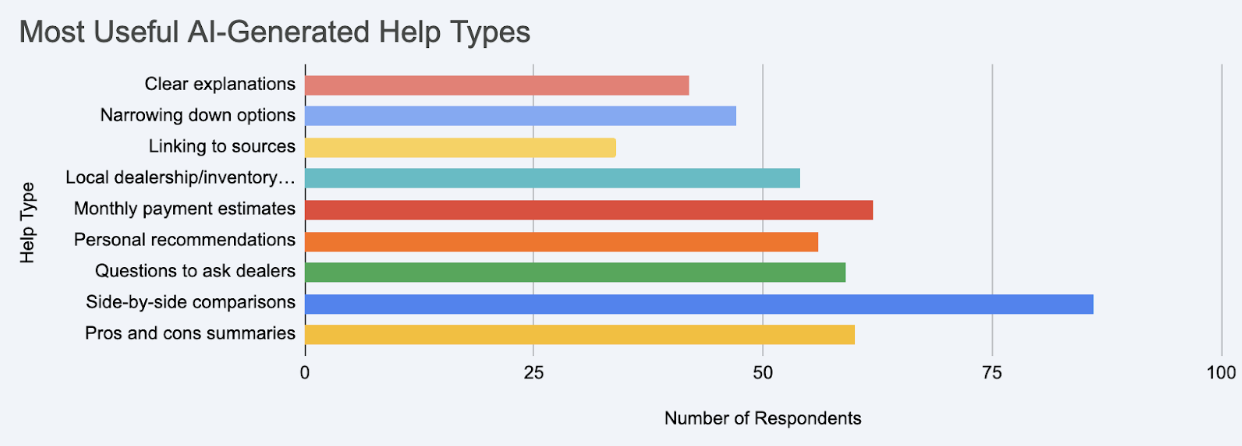
Taken together, this points clearly to the type of content that performs well in AI environments: content that is structured, easy to compare, grounded in real inventory, and connected to local availability. Content that is difficult to extract or synthesize is far less likely to surface, which means unclear, inconsistent, or unstructured dealer content effectively disappears from this part of the funnel.
Takeaways for Dealers
As AI adoption and trust continue to accelerate, dealers need to expand how they think about organic visibility, treating AI discoverability as a core part of their Organic Media and broader digital strategy.
That means building clear, structured comparisons across models, trims, and pricing that AI systems can easily interpret and surface. It means ensuring inventory data is clean, consistent, and machine-readable, so it can be pulled accurately into AI-driven results. And it means investing in reviews, local listings, and third-party presence, which are among the heaviest-weighted signals in AI-generated dealership recommendations.
The Bottom Line
AI isn't replacing traditional search: it's expanding upon it. Consumers are adding new tools into their buying journey, creating more decision-influencing moments and more surfaces where dealers need to appear. As adoption grows, the number of places where dealers need to show up increases. And as trust grows, the stakes of showing up well — with credible, structured, locally relevant content — increase right alongside it.
Dealers who adapt to this broader Organic Media ecosystem will be positioned to win across both search and AI-driven discovery. Those who don't risk being absent from an increasingly important part of the modern buying journey.
C-4 Analytics helps dealers translate fragmented buyer behavior into disciplined growth, aligning digital strategy, technology, and execution to win the moments that matter most. Schedule a free digital deep dive to explore your market’s unique opportunities in 2026 and beyond.