


Q3 2026 Auto Buyer Trends: Selectivity, Soft Loyalty and Price Sensitivity
Point to Pragmatic Shopping
Unlock Real-Time Auto Buyer Trends from the C-4 Analytics
Quarterly Consumer Intent Survey (QCIS)
The Q3 2026 automotive market is defined by a shift toward pragmatic decision-making. As consumer intent rises, shoppers are increasingly driven by discernment rather than impulse, prioritizing budget clarity, vehicle utility, and value.
Our latest Quarterly Consumer Intent Survey (QCIS) report reveals data that will help dealerships navigate this evolving landscape, offering actionable strategies to convert highly selective, brand-agnostic buyers into long-term customers.
Demand Remains Selective While Steadily Increasing
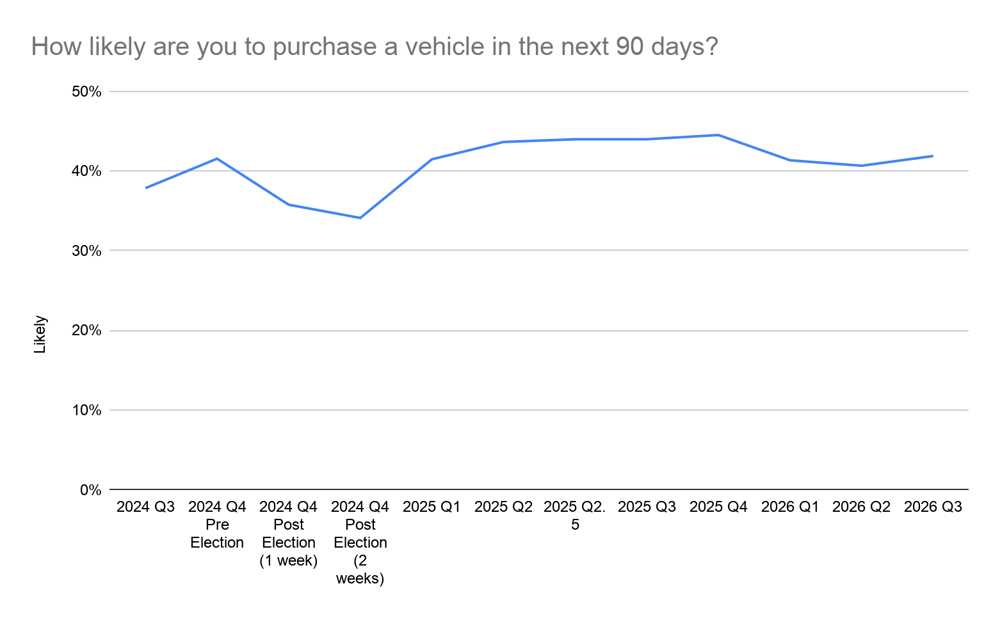
The good news for dealers: purchase intent rose modestly this quarter, with 42% of consumers saying they are likely to buy a vehicle in the next 90 days, up from 41% in Q2. That is not indicative of a market waiting for permission to spend, but rather one that will only spend with discernment.
The more important signal is underneath the number. The share of buyers who say they are purchasing because maintaining their current vehicle has gotten too expensive fell sharply, down almost 6 points quarter over quarter and the largest single move among all stated reasons.
At the same time, the share buying because they see a good opportunity or because of a positive life change both rose. Fewer people are being forced into the market by a breakdown, and more are choosing to enter it. The single most common reason to buy remains the chance to upgrade, cited by roughly 3 in 10 shoppers.
For dealers, the takeaway is that demand is present and improving in quality, but shoppers remain highly selective. These buyers do not have to act. They are choosing to, on their terms, which raises the bar for dealers.
Loyalty Is Up for Grabs
Here is the finding with the most strategic upside for any dealer trying to grow share: brand loyalty is soft and getting softer. The largest single-brand response this quarter was “no preference at all” at 35%, up more than 2 points from Q2 and now ahead of explicit preferences for both foreign and domestic makes, which sit in a dead heat at around a third each.
In other words, roughly 1 in 3 in-market buyers are not committed to anyone. And that openness does not disappear among serious shoppers. Even among consumers likely to buy in the next 90 days, no single brand camp holds a majority. These are winnable customers who are not yet beholden to any specific dealership, brand or model.
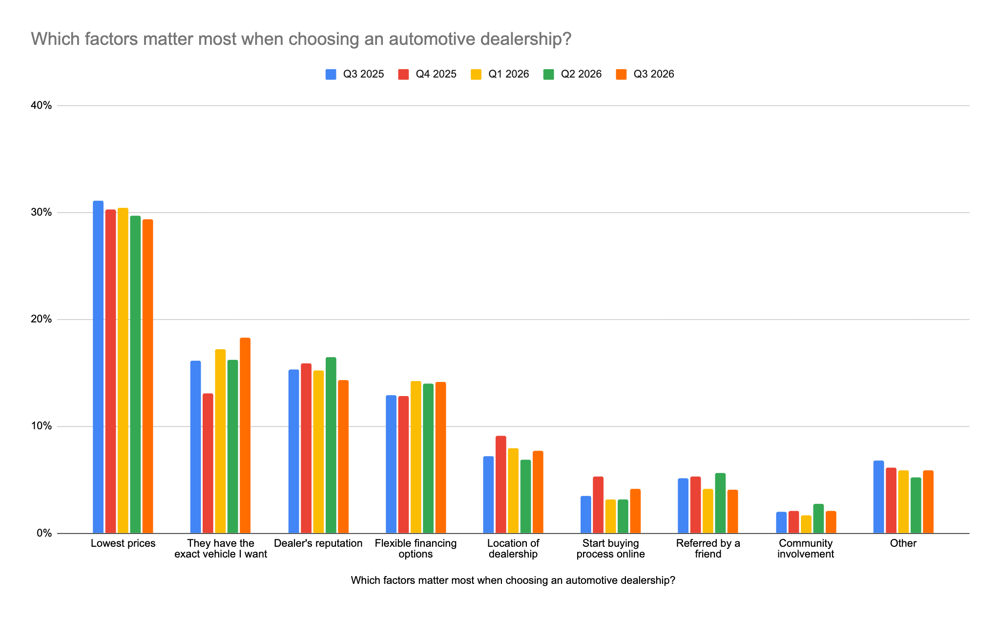
That reframes the competitive question. The dealer who wins the unaffiliated buyer does it on the things this report keeps surfacing: having the right vehicle in stock, a clear and credible price, and a buying experience that earns trust. Brand allegiance is not doing the work it used to. Availability, value, and confidence are.
Of particular note: this lack of loyalty extends to service, as a whopping 70% of respondents indicated they’re open to switching repair shops. Given that just 22% of consumers return to the selling dealer for service, this gives savvy dealerships a major inroad for reactivating lost customers.
SUVs and Hybrids Drive Primary Inventory Interest
If there is one merchandising story this quarter, it is the SUV. Interest in SUVs jumped more than 6 points to 45%, the single biggest move in the entire dataset, while interest in cars fell about 4 points and trucks softened. SUVs and cars together now account for roughly 8 in 10 stated vehicle preferences, and the balance shifted decisively toward the SUV in a single quarter.
This is the kind of movement that should show up in how a lot is stocked, priced, and marketed within weeks, not at the next model year. The pragmatic buyer is gravitating to the practical, do-everything vehicle, and visibility on in-stock SUVs is where a lot of Q3 intent will be won or lost. This is especially true given that about 35% of respondents still place a premium on searching for local inventory. 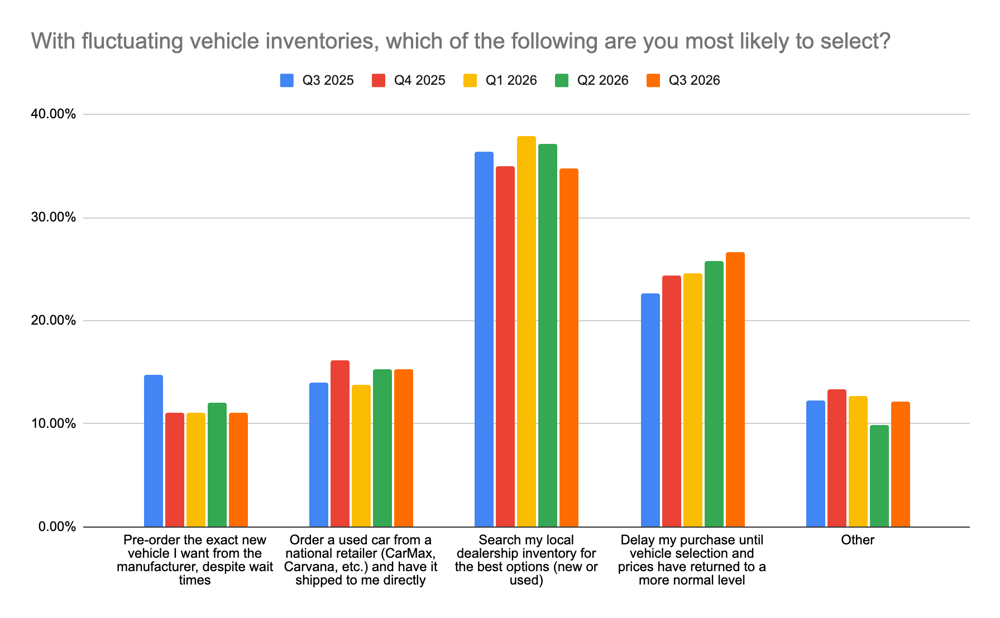
Additionally, the powertrain story found in our responses is one of pragmatism, not ideology. Gas remains the default at 62%, but the real movement is in the middle. Hybrid consideration rose to 28% while pure EV interest slipped to 10%, leaving hybrids ahead of EVs by nearly 3 to 1 and widening the gap from last quarter.
What makes this durable is that it is not a young-buyer fad. Hybrid interest holds steady between 27% and 28% across every age band we measured. EV interest, by contrast, roughly halves from younger to older shoppers. Hybrid is the option buyers reach for when they want efficiency without the cost, range, or charging questions that still give EVs pause.
Dealers who position hybrid inventory as the practical middle ground, rather than treating it as a niche, are merchandising to where demand is actually moving.
The Budget Wall Is Real, and Trade-In Transparency Remains Key
Selective demand has a hard edge: a budget wall that defines what these shoppers will and will not do. Half of consumers cap their total out-the-door price at $35,000 or below, and a comparable half cap their monthly payment at $550 or below, with 1 in 3 holding the line under $400 a month.
This is not aspirational budgeting. When asked what they would do if their ideal vehicle came in $100 a month over budget, only about 1 in 6 said they would still buy it. The rest would step down to a cheaper trim, move to a used or pre-owned model, delay, or were not sure. The wall holds even when the vehicle is right.
It also comes first. Roughly 4 in 10 shoppers decide a money number, either a target monthly payment or a total budget, before they settle on the vehicle itself. And when asked what is most affecting their decision right now, overall vehicle prices top the list. The practical implication is direct: payment and total-price clarity are not closing tools, they are qualifying tools, and they belong at the top of the funnel where the buyer is actually making the decision.
That said, for the pragmatic buyer, the deal does not always start with price: it starts at the valuation of their trade. Half of shoppers have a vehicle they may trade in, and 65% say it is important to know their estimated trade-in value before they will even discuss the price of the next vehicle. The trade is the opening move, and a dealer who tries to skip past it is negotiating against the buyer's expectations from the first minute.
What they want from that process is telling. The top priority is getting the highest dollar amount, but a fast, low-friction process and transparency in how the number was calculated follow close behind, and a majority say they would use a fast online trade-in tool that comes with a guaranteed written offer. Most important is what makes them quit: the single biggest reason shoppers stop negotiating is a trade offer that comes in below the online valuation they were shown. Late fees are a close second.
The lesson is to lead with an honest, online-first trade estimate at the top of the funnel and then stand behind it at the desk. When equity is there, it matters: most buyers would roll positive equity straight into their down payment, with others using it to lower the payment. The trade is not the end of the deal. For this buyer, it is the start of trust.
How Dealers Win in Q3 2026
The through-line across every finding is clear: the Q3 2026 buyer is in the market by choice, bound by a firm budget, open to many brands, and quick to walk away when the experience breaks trust. Winning that buyer comes down to four moves.
Qualify with money, up front. Put payment and total-price clarity where shoppers decide, at the top of the funnel. Lead with the out-the-door number, payment options, and terms, because half of these buyers will not cross their budget wall for any vehicle.
Merchandise to where demand is moving. Get in-stock SUVs and hybrid inventory front and center in organic search, on your site, and in paid media. This quarter's demand shifted toward a desire for practicality, and visibility into what is actually on your lot is now itself a conversion event.
Compete for the buyer with no hard preference. With 1 in 3 shoppers now brand-agnostic, conquest is not a stretch goal: it is your biggest opportunity. Win on availability, credible pricing, and trust rather than assuming loyalty will carry the day.
Make the trade the opening move, and keep it honest. Surface a fast, online-first trade estimate before the price conversation, and honor it through to the desk. The fastest way to lose this buyer is to provide a trade number that drops below what they were promised.
The Bottom Line
The Q3 2026 buyer is not waiting out the market. They are shopping it carefully, with a budget they will not break, no brand allegiances, and a low tolerance for processes that do not respect their time or their trust. Demand is there for dealers who meet it with clarity, the right inventory, and an honest deal. The pragmatic buyer is winnable. The dealer who earns that buyer is the one who makes the practical choice the easy one.
About the QCIS
The Quarterly Consumer Intent Survey (QCIS) is a proprietary research program developed and published by C-4 Analytics, now in its sixth year. Each quarter, the QCIS surveys more than a thousand in-market car shoppers nationwide on purchase intent, vehicle and brand preference, dealership selection, and the macro forces shaping buyer behavior, using consistent questions over time to track real movement. The Q3 2026 edition draws on a core consumer intent survey of 1,001 respondents, trended against 1,014 respondents in Q2 2026, and is supplemented by two focused Q3 2026 studies on affordability and trade-in of roughly 500 respondents each. Findings are published as actionable guidance for dealerships and automotive marketing professionals.
About C-4 Analytics
C-4 Analytics is a full-service automotive digital marketing agency that helps dealerships and dealer groups grow through data-driven SEO, paid search, social advertising, and content strategy. With offices in Boston, Ann Arbor, and Chicago, C-4 works with dealerships across the country to turn digital presence into measurable business results.
Want to see where these trends are showing up in your market? Claim your free digital deep dive and we will show you where the pragmatic buyer is, and how to win them.