


2026 Dealer Digital Trends Report
What Dealers Want From Marketing in 2026
In early 2026, C-4 Analytics surveyed dealers across the United States and Canada about their digital marketing priorities, frustrations and ambitions.
What’s emerged isn’t a story about channels or tactics, but one about confidence.
Digital marketing is fully embedded in dealership operations. Budgets are meaningful. AI is omnipresent. Expectations are high. But confidence in performance, data and partners is uneven at best.
In short, dealers aren’t questioning digital. They’re questioning whether digital is working as well as it should, and how they can meaningfully and accurately assess performance.
About the Respondents
This report reflects feedback from automotive dealers across the United States and Canada, representing a broad cross-section of markets and operating models.
Monthly digital advertising budgets among respondents ranged from under $5,000 to more than $30,000, with many falling between $5,000 and $29,999 per month. Dealership size also varied significantly, from stores selling fewer than 300 vehicles annually to high-volume operations exceeding 1,000 annual sales.
All major geographic regions were represented, offering a balanced view of dealer priorities across urban, suburban and rural markets.
While individual circumstances differ, the responses collectively reflect the perspectives of active operators managing real budgets in competitive environments.
Key takeaways from the survey include:
1) The Confidence Gap Is Growing
Most dealers describe themselves as only somewhat satisfied with their digital marketing. Very few report being highly satisfied. Vendor confidence follows the same pattern.
That combination suggests something deeper than routine dissatisfaction. It says dealers are not seeing clear, defensible cause and effect between spend and sales.
How satisfied are you with your current digital marketing’s impact on your dealership’s new and used vehicle sales?
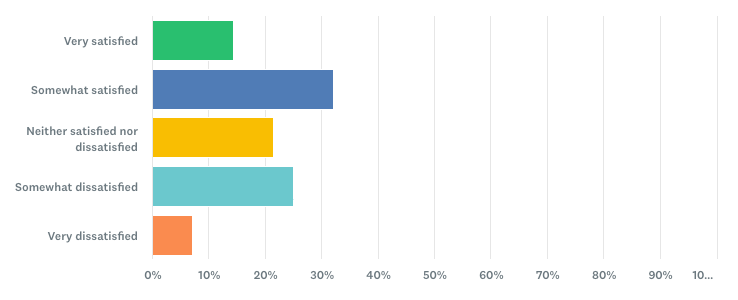
When confidence is strong, dealers tolerate volatility. They understand that not every month will break records. What they need is belief in the system behind the results.
When confidence is weak, every dip feels structural. Every underperforming month invites scrutiny. Every report is questioned.
The responses indicate that many dealers are operating in that second mode. This is the confidence gap, and it stems from meaningful investment paired with partial trust.
Dealers are making it clear that closing that gap won’t come by adding more reporting. It will come from strengthening attribution, improving lead quality and aligning marketing metrics with dealership reality.
2) A Shift From Volume to Efficiency
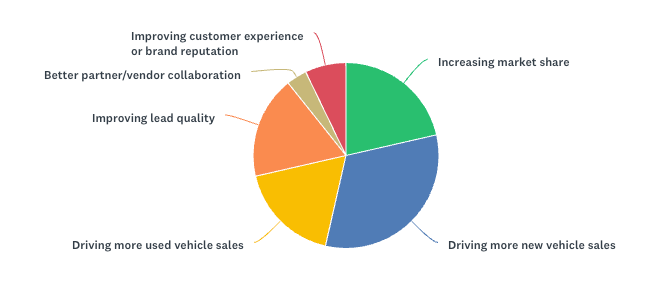
This shift in dealer priorities is subtle but important. The dominant concerns dealers relayed are not related to earning “more impressions” or “more traffic.” They center on:
- Driving actual vehicle sales
- Improving lead quality
- Tightening attribution
- Reducing wasted spend
That pattern signals a move from expansion to refinement. For years, digital strategy often defaulted to volume. More reach. More leads. More channels. Growth was equated with scale.
What is the single biggest marketing priority or pain point for your store right now?
Today, scale without efficiency feels expensive.
Lead quality, in particular, is no longer a marketing-only issue. Poor leads erode trust internally. Sales teams disengage. BDC performance suffers. Managers begin to discount marketing numbers altogether. Once that internal skepticism sets in, it is difficult to reverse.
Dealers are not asking for more noise, but for better signals. This is a maturing market, and one in which efficiency is becoming the differentiator.
3) Better Benchmarking and the Search for Context
One of the most revealing signals in the survey is the strong interest in benchmarking tools and peer comparison.
At first glance, this looks like a request for more data. It is not. It is a request for context.
Dealers feel as though they lack the context required to take meaningful action against the sea of metrics, data and information with which they are constantly bombarded. A cost per lead or ROAS figure means very little in isolation. Without comparison, performance is abstract.
True benchmarking transforms data into positioning. It helps dealers answer questions like:
- Am I outperforming similar rooftops?
- Are my costs rising faster than the market?
- Is my ROI competitive or just acceptable?
Those questions are strategic, not tactical. They reflect a deeper shift in mindset. Dealers are no longer satisfied knowing whether campaigns are “on track.” They want to know where they stand.
This desire for comparison also signals competitive pressure. As consolidation increases and larger groups refine their marketing sophistication, independent operators and smaller groups feel the need for clearer reference points.
Where do dealers feel as though benchmarking would be most helpful? Common answers include:
- Website conversion rates
- Third-party ad spend
- Media mix
- SEO and AI search performance
Benchmarking for these areas and others reduces uncertainty. It also raises standards. Once a dealer sees that peers are generating higher conversion rates or stronger ROI at similar spend levels, “somewhat satisfied” becomes untenable.
That is why benchmarking interest is so strong. It introduces accountability without requiring blind trust.
4) Ever-Present AI: High Awareness, Low Integration
It’s 2026, so of course, AI surfaced repeatedly as an area of interest. Dealers see its potential in attribution modeling, campaign optimization and forecasting consumer behavior. But, most do not describe AI as something actively reshaping their current strategy.
This gap is important.
In many industries, AI adoption follows a predictable pattern. Curiosity comes first. Tool experimentation follows. Strategic integration lags. Automotive retail appears to be in the early-middle phase of that cycle.
Dealers recognize that AI could:
- Improve targeting precision
- Surface stronger audience insights
- Predict demand shifts
- Clarify multi-touch attribution
What they lack is operational clarity. Dealers have yet to see how AI will actually plug into their marketing systems, how it can augment decision-making, and how it can tangibly improve revenue, not just efficiency metrics.
Until those questions are answered concretely, AI remains aspirational.